

Case Study 04
Meteorological Model Comparison for Flood Prediction
How well do DestinE and ARSO ALADIN forecasts match real measurements in Slovenia?
This case study compares DestinE and ARSO ALADIN forecasts with
measurements from 13 ARSO meteorological stations to assess temperature
and precipitation performance across forecast lead times from 12 to 72 hours.

What this case study shows
Two forecast models
DestinE and ARSO ALADIN are evaluated using the same observations.
13 ARSO stations
Ground measurements across Slovenia provide the reference data.
12–72 h forecasts
Performance is compared across six forecast lead times.
Flood-prediction relevance
Temperature and precipitation accuracy help assess the suitability
of meteorological inputs for flood-risk applications.
The Challenge
How reliable are weather forecasts for flood prediction?
Accurate meteorological forecasts are essential for anticipating
heavy rainfall and potential flooding.
DestinE and ARSO ALADIN use different modelling approaches,
spatial resolutions and computational frameworks. Their forecasts
therefore need to be compared against real measurements under
Slovenian conditions.
The goal is to understand how well both models reproduce
observed temperature and precipitation.
How the comparison works
From forecast data to model performance
01
Forecast models
DestinE and ARSO ALADIN forecasts are collected for comparison.
02
Ground observations
Measurements from 13 ARSO stations provide the reference data.
03
Variables
2 m air temperature and accumulated precipitation are evaluated.
04
Lead times
Forecasts are compared at 12, 24, 36, 48, 60 and 72 hours.
05
Error metrics
Bias, MAE and RMSE quantify the difference between forecasts and observations.
06
Model comparison
Both models are benchmarked against the same observed conditions.
The same observations, variables and forecast periods are used to provide
a consistent comparison between the two models.
The two forecast products
Two models, two forecasting approaches
DestinE
Destination Earth meteorological forecast
A next-generation meteorological forecast product developed
within the European Commission’s Destination Earth initiative
and digital-twin infrastructure.
Destination Earth
ARSO ALADIN
Operational regional forecast
ARSO uses the ALADIN numerical weather prediction model
for operational regional forecasting adapted to Slovenian
geographical and climatic conditions.
Operational in Slovenia · ARSO
Comparison setup
A consistent benchmark across Slovenia
13
ARSO stations
1 month
18 Feb – 18 Mar 2026
2
meteorological variables
6
forecast lead times
Temperature — T2m [°C]
Compared at the exact forecast valid time.
Precipitation — accumulated rainfall [mm]
Compared over the corresponding forecast accumulation period.
Forecast performance is evaluated consistently across
12, 24, 36, 48, 60 and 72-hour
lead times.
Results
Comparison across 13 meteorological stations
ARSO ground measurements from 13 stations across Slovenia were used
as the reference for comparing DestinE and ARSO ALADIN forecasts.
13
ARSO stations
Slovenia
national coverage
Ground-reference observations
Station measurements provide the real-world reference needed to
evaluate forecast performance under Slovenian conditions.
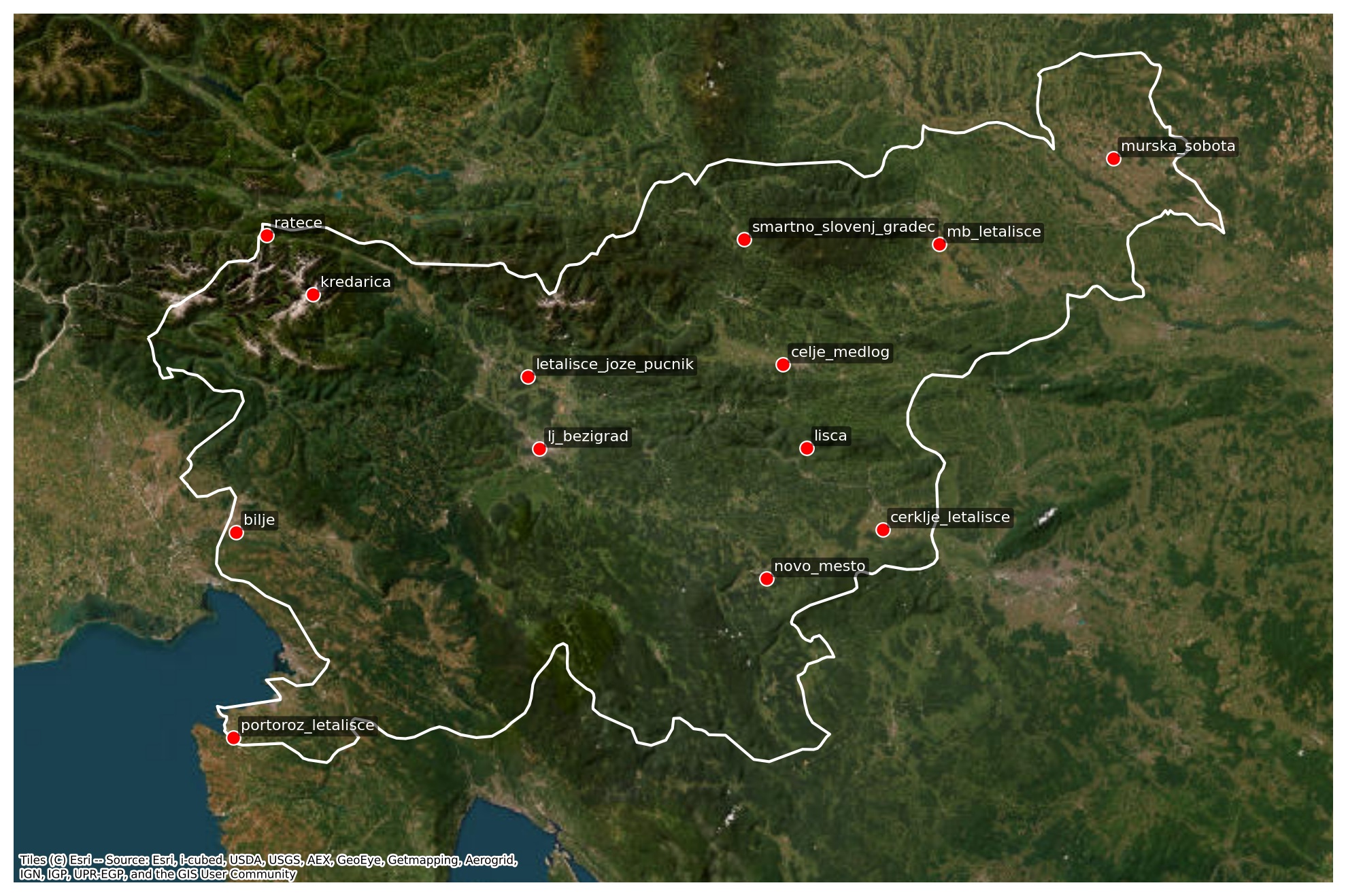
Selected ARSO meteorological stations used in the comparison.
Red markers show the ground-reference stations.
Forecast example
What do the two models predict?
The example below compares a 72-hour forecast from ARSO ALADIN
and DestinE over Slovenia for temperature and accumulated precipitation.
How to read the figure
Top row
ARSO ALADIN
Bottom row
DestinE
Left
2 m air temperature
Right
Accumulated precipitation
Forecast lead
72 hours
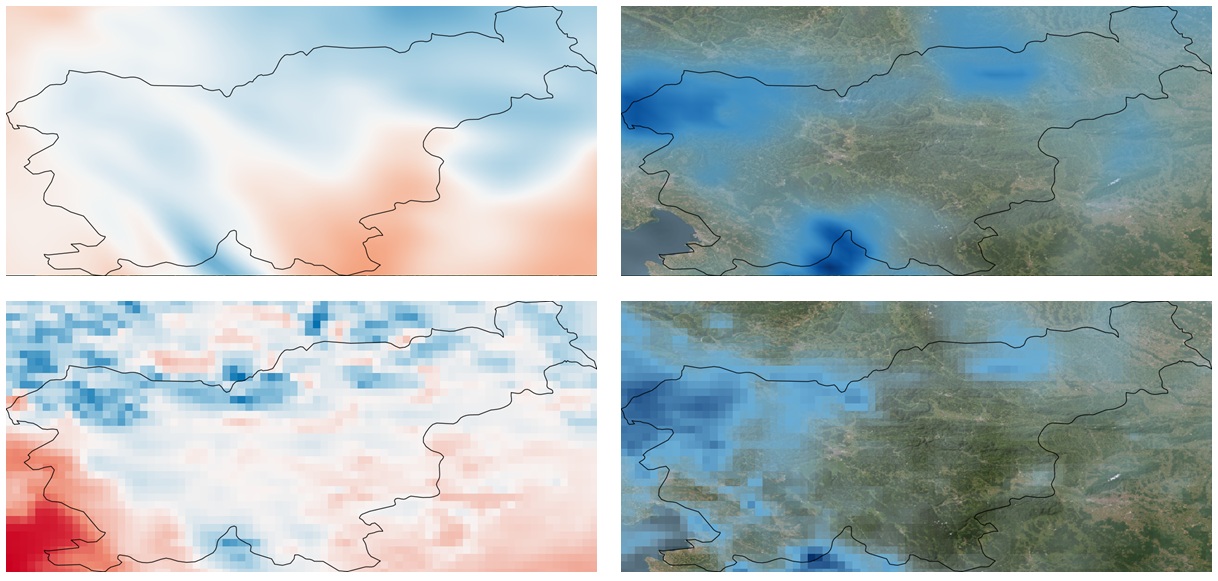
Example 72-hour forecast over Slovenia.
Initialized on 18 February 2026 at 00:00 UTC and valid on
21 February 2026 at 00:00 UTC.
Performance example
How accurate were the 24-hour forecasts?
The example compares observations at Portorož–Letališče with
24-hour forecasts from ARSO ALADIN and DestinE.
Portorož–Letališče
Example ARSO ground-reference station.
24-hour forecast
Both forecast products are compared against the same observations.
How to read the results
Lower error values indicate forecasts that are closer to the
observed conditions.
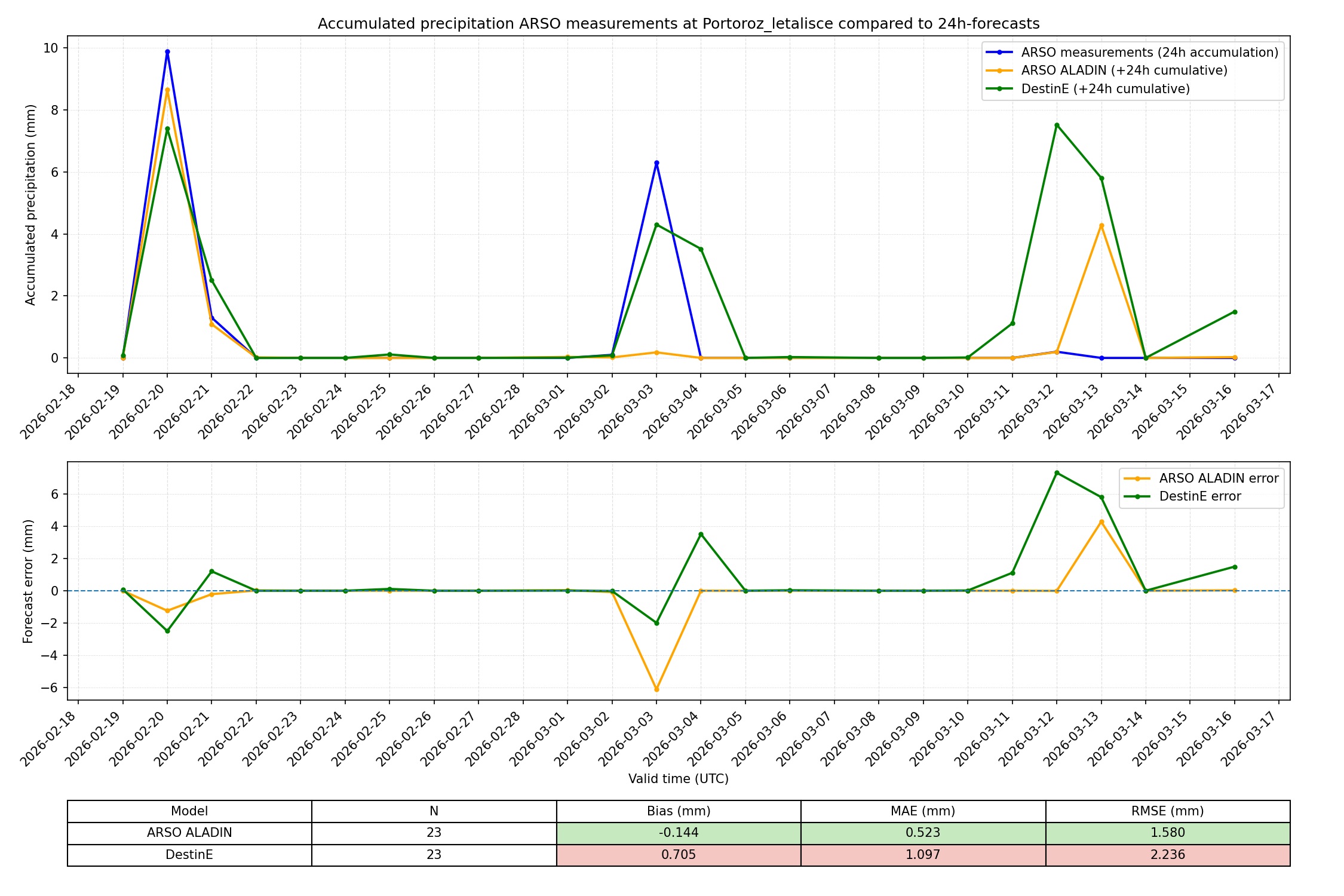
24-hour forecast comparison at Portorož–Letališče.
Observations are compared with ARSO ALADIN and DestinE forecasts
for temperature and precipitation.
Bias
Shows whether a model systematically tends to overestimate
or underestimate the observed value.
MAE
Mean Absolute Error shows the average magnitude of the
forecast error.
RMSE
Root Mean Square Error gives greater weight to larger
forecast errors.
Lower error
Better agreement with observations.
Higher error
Larger difference from observations.
Key findings
What did the preliminary comparison show?
The initial comparison provides a first indication of how DestinE
and ARSO ALADIN perform against ground observations in Slovenia.
Temperature
Broadly comparable performance
Both DestinE and ARSO ALADIN showed generally comparable
performance for 2 m air temperature during the analysed period.
Precipitation
DestinE showed promising results
DestinE generally showed better precipitation performance
than ARSO ALADIN, particularly at shorter forecast lead times.
Important context
A preliminary benchmark
The analysis covers only one month and should therefore be
interpreted as an initial comparison rather than a complete
assessment of high-impact weather events.
Main takeaway
The results show that DestinE can provide meteorological forecast
information that is relevant for integration into Digital Twin
workflows, while longer-term evaluation is needed for robust
conclusions on extreme rainfall and flood-related events.