Strengthening Disaster Resilience through the Digital Twin of Slovenia (DTSI)
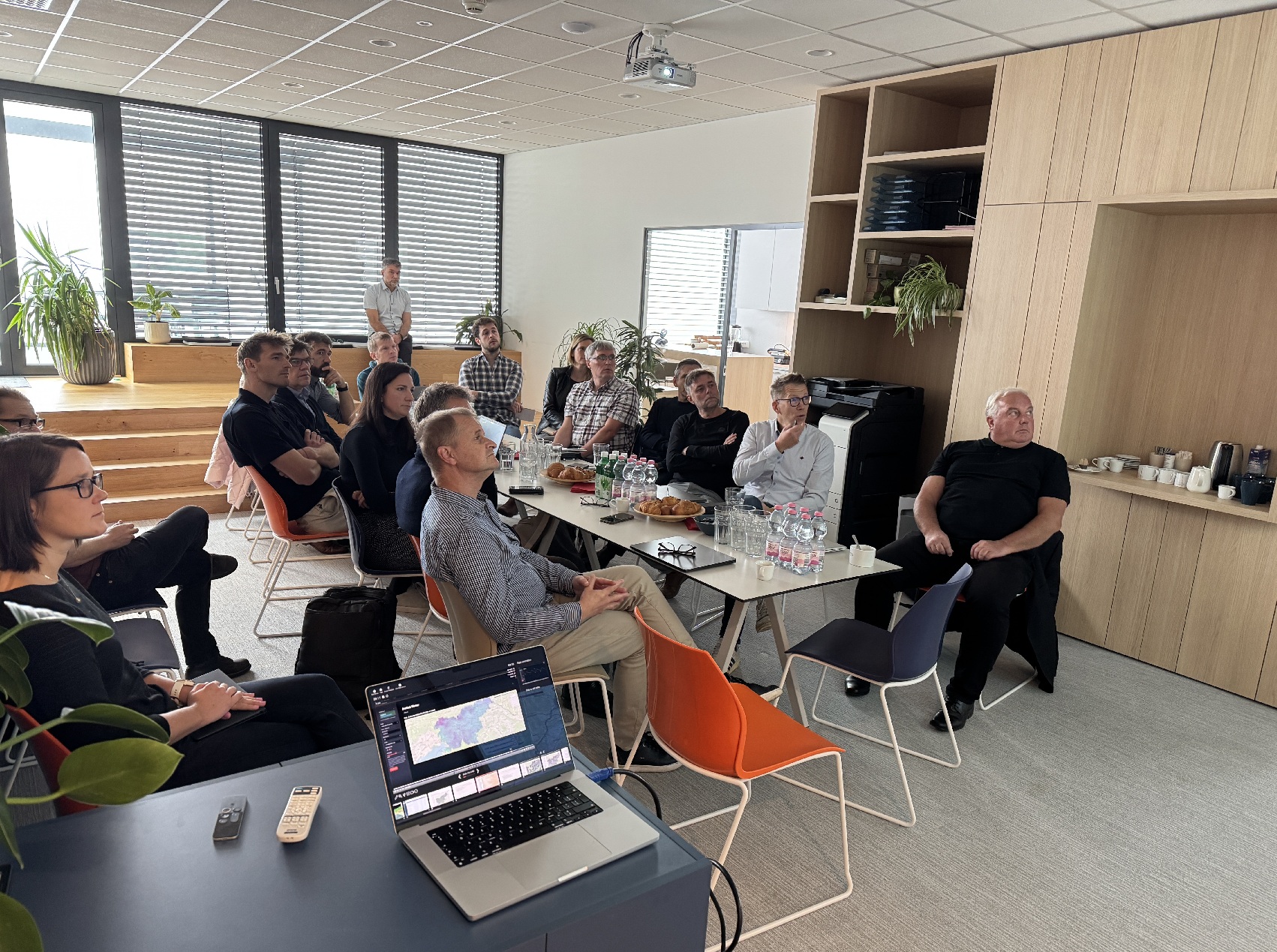
A professional event took place at the premises of Flycom Technologies, where project partners presented the working methodology and key achievements of the DTSI Core and DTSI Applications projects, as well as the first development results of the Digital Twin of Slovenia (DTSI) designed to support decision-making during natural disasters. The discussion focused on the next steps: improving the integration of data, models, and user processes; clarifying stakeholder roles; enhancing interoperability; and gradually upgrading the prototype into a robust system for analysis, early warning, and simulations. The event confirmed the cooperation of key Slovenian stakeholders and the potential for further integration into EU initiatives, concluding with a direction toward preparing a central development roadmap for the next phase of DTSI.
Following the presentations, an expert discussion addressed how to shape a broader vision for the development of DTSI and prepare a DTSI development roadmap as a key outcome for future decisions. The discussion focused on what is required to transition from the currently demonstrated prototype to a broader, potentially national solution for managing natural disasters. Participants emphasized the need for an evaluation that would enable a realistic assessment of feasibility, required time, and resources, as well as the possibility of gradually expanding existing modeling cases to larger areas.
Participants also highlighted practical experiences, particularly that during the 2023 floods, shortcomings were evident at the national level due to the lack of a unified data model and uncoordinated processes. A key advantage of DTSI identified during the discussion was its potential to integrate multiple data sources, enable rapid spatial analyses, and support applications that can assist decision-making and accelerate field response in crisis situations. It was also noted that without real-time measurements an effective early warning system cannot be established; however, the overall development direction is appropriate and, in the long term, cost-effective compared to post-disaster recovery.
An important emphasis was also placed on the need for a clear definition of end users and stakeholders. The discussion highlighted that communication toward users should be less technical and more focused on usability, as users are primarily interested in what the system enables and how it supports their operational processes. It was also noted that there is potential for transferring such solutions to the EU level and beyond, provided that the necessary data and process prerequisites are met.
A specific topic of discussion concerned the practical usability of Earth Observation (EO) data during disasters. Currently, EO data are successfully used for post-event damage assessment, whereas operational services in crisis situations often require immediate information. Limitations such as data availability and especially cloud cover remain significant challenges. The importance of continuous data acquisition, validation, and accumulated expertise for correct interpretation of results was therefore emphasized.
For the future, participants proposed developing DTSI as a broader risk assessment and management service, integrating both existing and future models. Open questions remain regarding integration and infrastructure, including platforms, connections to relevant data sources, the use of API technologies, and issues related to data publication and accessibility.
As an example of good practice in the use of satellite data, the mapping of the affected area during the Karst wildfire using Sentinel-2 imagery was highlighted, which enabled further professional analyses and improved information dissemination.
The meeting concluded with a consensus that the development roadmap must be the central outcome: a conceptual and accessible document that clearly defines the scope, priorities, target users, and the pathway toward a robust system that can serve as the foundation for future decisions and potential funding of subsequent development phases.