Case Study 02
Near real-time monitoring of an intermittent karst lake
This case study combines Earth Observation, in-situ hydrological
measurements and high-resolution terrain data to monitor the changing
extent of Lake Cerknica and support water and habitat management.

What this case study shows
Near real-time water extent
Track how the lake fills and drains over time.
EO + in-situ data
Combine satellite observations with measured water levels.
High-resolution terrain
Capture fine-scale lake and terrain variability.
Better decisions
Support water, habitat and protected-area management.
The Challenge
A lake that can
change within
days
change within
days
Lake Cerknica is a highly dynamic intermittent karst lake. Rapid filling and gradual drainage affect biodiversity, land use, water management and public safety.
Conventional observations alone cannot fully describe the spatial and temporal variability of such a rapidly changing environment.
How the Digital Twin works
From observation to near-real-time lake extent
01
Water levels
ARSO measurements
02
Terrain
LiDAR + UAV DEM
03
Satellite EO
Sentinel + PlanetScope
04
Water masks
NDWI / MNDWI
05
Visualisation
3D + LIFT
Monitoring in action
How the water extent changes over time
A short time-based comparison makes the changing water extent easier to understand than a single static map.
Map interpretation
Show the observation date, identify the data source and explain clearly what each colour represents.
Data behind the Digital Twin
Earth Observation and terrain data behind the Digital Twin
Different data sources provide complementary information for monitoring,
modelling and validating the changing extent of Lake Cerknica.
High-resolution terrain data
LiDAR + UAV DEM
High-resolution elevation data provide the terrain foundation for the
Digital Twin and support detailed representation of the lake basin and
surrounding landscape.
Spatial resolution
LiDAR: 1 m
UAV DEM: 5 cm
UAV DEM: 5 cm
Repeated Earth Observation
Sentinel + PlanetScope
Repeated satellite observations provide information on changing surface
conditions and support the detection and validation of water extent
over time.
Data sources
Sentinel-1
Sentinel-2
PlanetScope
Sentinel-2
PlanetScope
Derived information
Water masks
Water masks derived from Earth Observation data are used to identify
water-covered areas and compare changes between observation dates and
data sources.
Water indices
NDWI · MNDWI
From data to water extent
Terrain data describe where water can spread, repeated Earth Observation
captures changing surface conditions, and derived water masks show how
the lake extent changes over time.
Explore the applications
Explore Lake Cerknica in more detail
Continue from the case study to the dedicated applications and explore
changing water extent and lake dynamics through interactive tools.
Monitoring platform
Lake Cerknica Flood Monitoring Platform
Explore the dedicated flood-monitoring environment and investigate
changing water extent and lake dynamics.
Near-real-time application
Near-Real-Time Lake Cerknica
Explore near-real-time information on the changing water extent
of Lake Cerknica.
Digital Twin visualisation
See the Digital Twin in action
Explore the 3D representation of Lake Cerknica and see how terrain,
water extent and Earth Observation data come together in the
Digital Twin.
3D visualisation of Lake Cerknica within the Digital Twin environment.
Results and impact
Turning observations into actionable insight
The Digital Twin brings together terrain, Earth Observation and water-extent
information to support monitoring, analysis and decision-making around
Lake Cerknica.
Near-real-time water extent
Monitor changing lake extent through repeated observations and
derived water masks.
Understanding lake dynamics
Follow filling and drainage patterns and compare changes between
different observation dates.
Scenario analysis
Support the analysis of flood and drought conditions using terrain,
Earth Observation and water-extent information.
Biodiversity & habitat intelligence
Provide spatial information that can support habitat monitoring and
protected-area management.
From monitoring to better decisions
By combining repeated observations with detailed terrain information,
the Digital Twin helps turn changing lake conditions into information
that is easier to interpret and use.
Historical perspective
Comparing Lake Cerknica’s water dynamics through time
The historical comparison provides insight into how the spatial
distribution and duration of water presence differ between selected
years, extending the analysis beyond present-day monitoring.
1954
1972
2014
2022
Why it matters
Looking across different periods helps place current lake conditions
into a longer-term context and makes differences in water-presence
patterns easier to interpret.
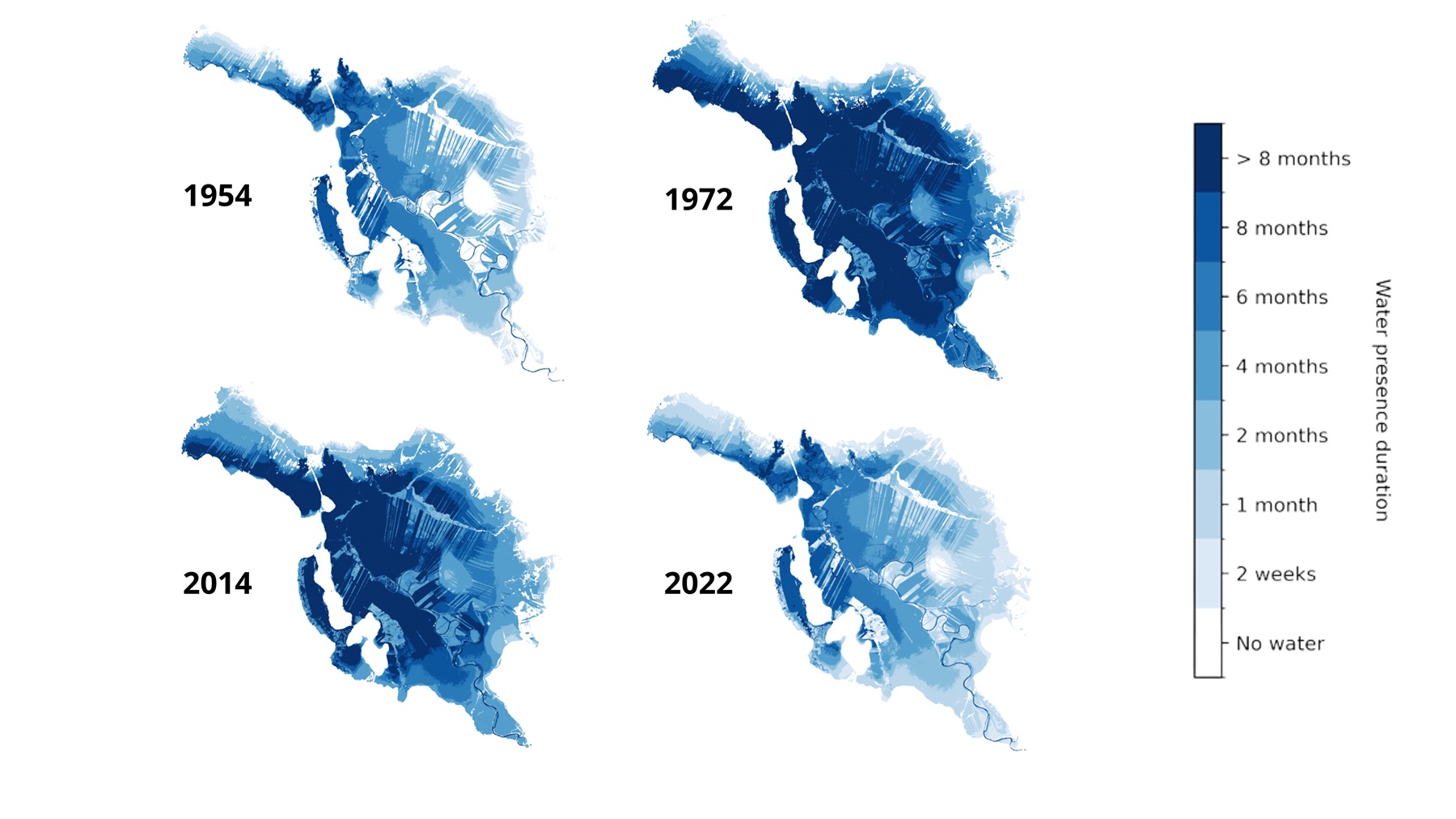
Water presence duration for selected years:
1954, 1972, 2014 and 2022. Darker blue areas indicate locations
where water was present for a longer duration.